Bosch Car Multimedia tested a model-based approach to system design based on the 3DEXPERIENCE platform to effectively connect all disciplines in product development.

The possibilities of connectivity open new horizons for the development of intelligent vehicles and mobile services that make cars safer, more efficient, convenient, and enjoyable. Intelligent mobility solutions offer a completely new way to control a vehicle, for example, through vehicle-to-vehicle (V2V) or vehicle-to-infrastructure (V2I) communication. Bosch Car Multimedia, a division of Bosch Mobility Solutions, connects the interior and exterior of the vehicle by integrating automotive technologies, cloud data, and digital services to provide comprehensive mobility solutions for drivers and passengers. “Connectivity offers enormous potential,” said Martin Gaedtke, Director of Instrumentation Systems at Bosch Car Multimedia. “However, it leads to increased complexity in our products and processes.”
Bosch Car Multimedia believes that the evolution of digital technologies and the nearly limitless connectivity options that facilitate driving and entertain passengers throughout their journey create a third living space alongside home and office. “We call this third living space the ‘travel space.’ For example, with an autonomous vehicle, people can commute to work in the morning while holding meetings on the way. Our job is to provide infotainment systems and networking solutions that can make this happen,” Gaedtke said.
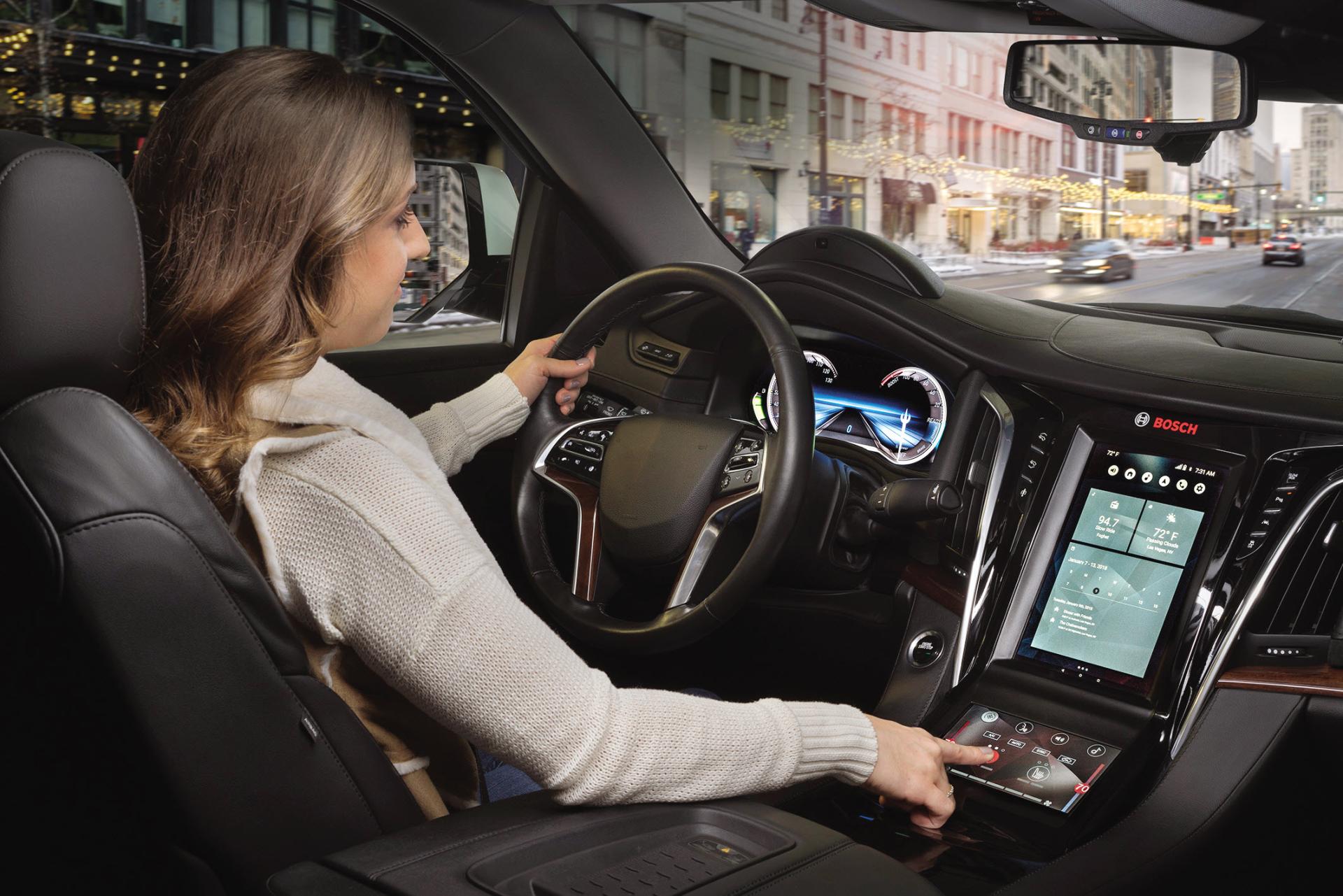
The Bosch Car Multimedia mechanics division is responsible for developing components and the overall design concept of vehicle interior displays. “Connectivity forces us to design very complex systems, hence their complexity,” said Bernd Hirt, head of the core functional mechanics group at Bosch Car Multimedia.
However, different disciplines within this business unit, pursuing the same goals—such as developing a new product for an automotive manufacturer—primarily used different software solutions. With fragmented work, potential mutual influences on the entire system were often detected very late, leading to higher costs. “In the development process, you have different stakeholders contributing to projects, working with their own tools, and exchanging projects through interfaces,” said Christian Simonis, project coordinator for model-based system design concept verification at Bosch Car Multimedia. “The danger is that a lot of information gets lost. This is an inefficient way of working.” “In an era of increasing connectivity in our lives, as developers of network solutions, we must work together to create a holistic digital model with all the attributes of each area. This will invariably shorten time to market because we will be able to work faster and more efficiently,” said Bernd Hirt.

A comprehensive digital model that includes all attributes of each discipline consistently reduces time to market because we can work faster and more efficiently.
To cope with the complexity of modern connectivity systems, companies had to reorganize their engineering processes by integrating disciplines and making them work more cohesively. As a long-time user of CATIA from Dassault Systèmes, Bosch Car Multimedia utilized the 3DEXPERIENCE® platform for a proof of concept (PoC) to develop a combined head-up display (CHUD) for better understanding the system’s kinematics.
CHUD uses a small plastic screen located between the steering wheel and the windshield to project virtual images, such as navigation information or traffic rules, into the driver’s line of sight. “We wanted to analyze the potential of model-based systems design methodology on the collaborative platform. With years of collaboration with Dassault Systèmes, the 3DEXPERIENCE platform was a logical choice. It was important to be able to bring together distributed teams and integrate the existing systems of each individual discipline into the platform, and that is what we aimed to demonstrate with this proof of concept,” said Bernd Hirt.
Bosch Car Multimedia used, among other e-learning courses, Dassault Systèmes Companion eLearning, so that designers and engineers could quickly master the 3DEXPERIENCE platform. “We also use accompanying tutorials to train new employees. Training can be assigned based on role or area of responsibility and can be scheduled according to requirements and work schedules,” said Mark Olshleger, systems verification engineer at Bosch Car Multimedia. “We use model-based systems development to account for the requirements of mechanics, software, hardware, and kinematics in different areas, extract logical elements from them, and then physically model our projects on the 3DEXPERIENCE platform,” said Simonis. “I emphasize this interdisciplinary aspect because the ability to assess how a software parameter, for example,
“As a project coordinator, using a model-based systems engineering approach makes it easier for me to integrate individual disciplines and evaluate them holistically,” Simonis added. “This preliminary loading is necessary if we want to assess product performance at an early stage, rather than after physical integration and testing. Another advantage of model-based systems engineering is that you can work with the most recent and relevant data. There are no delays due to exporting or importing models; any model developer, regardless of their field, can always access the latest versions of projects from their colleagues.” Since all applications are integrated into the platform, seamless data continuity is ensured. “For example, a finite element method (FEM) engineer develops their simulation model on the 3DEXPERIENCE platform,
According to Jürgen Hirt, project manager for the integration of projection displays at Bosch Car Multimedia, model-based systems development also helps the company reduce recursion in product development due to the holistic understanding of the system obtained, significantly shortening development time and reducing costs. “Regarding the verification of our projects, the model-based systems design approach allows me to answer questions such as ‘does my product really do what my customer expects?’ or ‘can I verify subsystems even if the complete environment is not yet fully defined?’ In other words, can I use software or hardware to model the cycle?” said Olshleger. “The answer to all these questions is positive because all the necessary information is stored in one common digital model. This knowledge base allows for subsystem verification at the earliest stages,

A comprehensive digital model that includes all attributes of each discipline consistently reduces time to market because we can work faster and more efficiently.
“When designing the system architecture, it is important to consider the system requirements to determine how its components physically work together,” says Micha Schenweisner, systems behavior engineer at Bosch Car Multimedia. “Previously, the correct detection of design errors, such as collisions or something not working properly, could only be done with physical prototypes,” he added. “Now, after modeling, I can digitally see if everything works as it should and show in 3D how adjusting certain parameters will affect the operation of the entire product.”
“Thanks to the modeling approach, we can analyze concepts and their shortcomings faster, taking into account all tolerances at early stages of development so that the system can be properly interpreted,” said Martin Schmidt, director of the customer program at Bosch Car Multimedia. “For example, through kinematic modeling and behavior modeling, we were able to adapt the design of the clog detection algorithm, which practically eliminates the risk of finger injuries. The kinematics of the projection display is complex; virtual simulation is like a digital X-ray that allows us to visualize what happens in various use cases. This visual demonstration was significant during discussions of the CHUD kinematics with our customer, and we received very positive feedback regarding the model-based systems approach we adhered to here. Schmidt also mentioned that the company sees benefits in terms of sales. “Requests for quotes are processed faster because we can present our proposals in less time thanks to the knowledge gained from previous projects and the ability to reuse information capitalized in the system,” he said.
Miguel Filipe Santos, a software engineer at Bosch Car Multimedia, said that the model-based design approach fosters discussion and collaboration, improving the teamwork of software developers, mechanics, and hardware engineers. “We fully understand the specific requirements of our clients, which is an important part of software development. And we can virtually verify how our programs interact with other systems. This is key to developing good software,” he said. “Moreover, we can implement what the client wants with the required level of quality and almost immediately, which significantly saves time on debugging sessions.”
“As engineers,” added Patrick Ubele, a mechanical engineer at Bosch Car Multimedia, “we are also the link between OEM manufacturers and suppliers, which means we need to know the requirements that OEM manufacturers impose on our products and, in turn, translate these requirements into individual components for our suppliers. Working with the 3DEXPERIENCE platform helps us clearly know and describe these requirements from the very beginning of the project and continuously compare them with our designs to ensure full compliance. Additionally, we no longer need to process data separately for different stages, such as kinematics or thermal modeling, which significantly saves working time.”
Initiatives like A-SPICE1 are driving the automotive industry. “By using the platform, we can ensure digital continuity from requirements to verification. It was important for us to be able to integrate existing systems from each individual discipline; this was something we successfully confirmed with our proof of concept,” said Gedtke. “Overall, platforms like 3DEXPERIENCE from Dassault Systèmes provide a holistic approach to the MBSE methodology. As a result, we achieve competitive advantages that strengthen our future.”

bosch car media logo At the center of Bosch Car Multimedia Bosch Car Multimedia (CM) is part of the Bosch Mobility Solutions business sector of Robert Bosch GmbH. With its intelligent solutions, CM contributes to a more flexible and efficient integration of automotive entertainment systems, navigation, telematics, and driver assistance systems, while maintaining maximum user convenience. CM develops specialized hardware and software solutions used in the latest products and actively helps shape the future of connected mobility. The range includes information and infotainment systems for drivers, as well as freely programmable instrument systems used on a global scale.
Products: solutions for infotainment systems, displays, communication means, and human-machine interfaces with a focus on engaging user experience and utmost ease of use.
Partners: 8,250 (as of December 2017)
Sales volume: €2.6 billion (as of December 2018)
Headquarters: Hildesheim, Germany
For more information: https://www.bosch-mobility-solutions.com/en/

