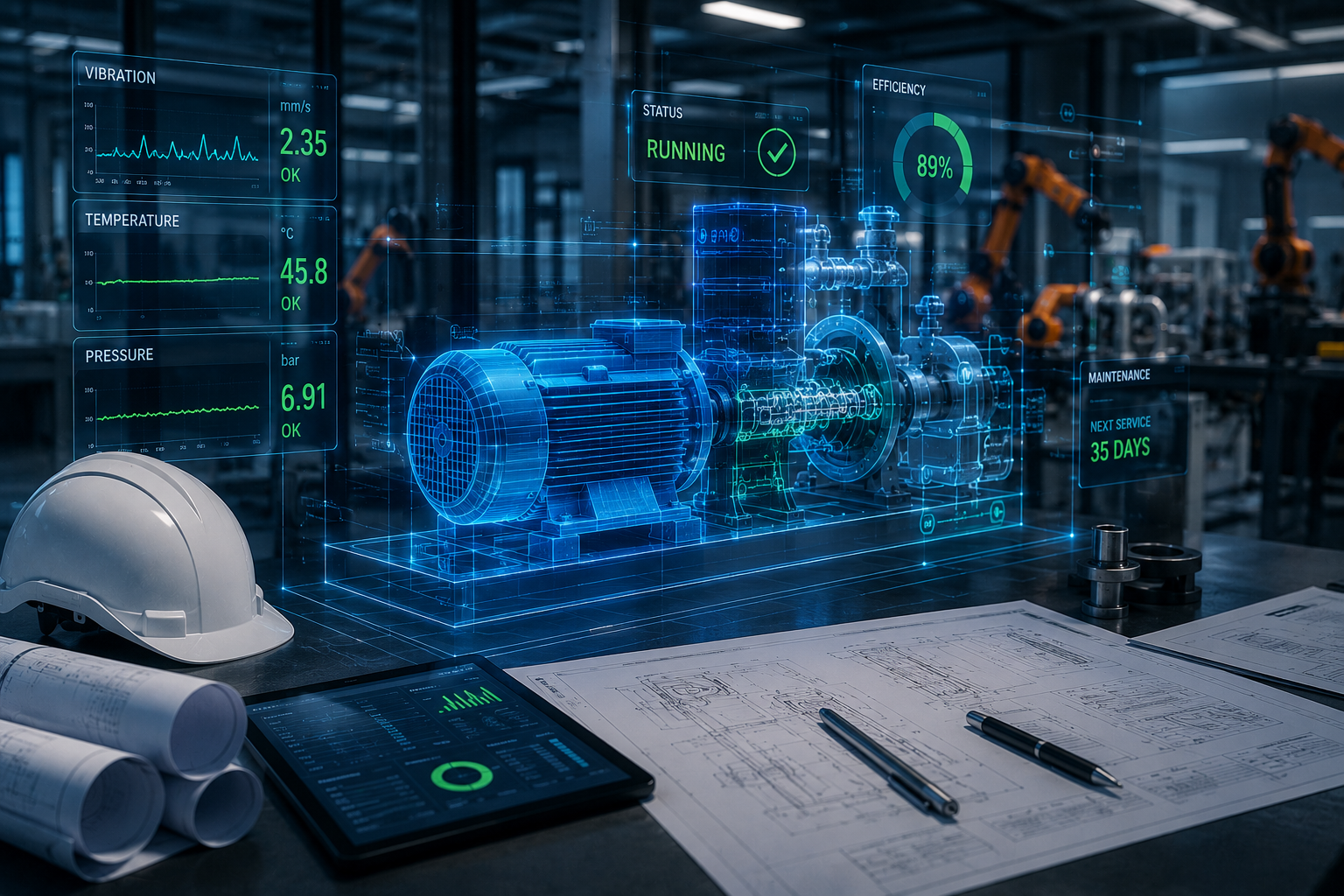
A digital twin is a virtual model of a physical object: a machine tool, a production line, an individual component or an entire factory. It receives data from sensors in real time and displays the current status of the equipment. Data such as vibration, temperature, load, pressure, operating speed or the number of production cycles can be transmitted to such a model. This allows engineers to see not just a “picture” of the object, but its actual behaviour during operation.
Digital twins are used at various stages of an asset’s life cycle: during design, commissioning, operation and maintenance. For example, for a CNC machine tool, such a model can indicate spindle overheating or increased vibration even before an emergency shutdown occurs. Unlike a conventional 3D model, which remains static once created in CAD, the Digital Twin is constantly updated and linked to the real equipment. This is precisely why Industry 4.0 regards it as a tool for data-driven monitoring, forecasting and production management.
A 3D model is a static geometric representation of equipment created in CAD for design, structural verification and documentation preparation. A digital twin works differently: it synchronises with the physical object via IoT sensors and updates parameters in real time. For example, for a CNC machine tool, such a model shows not only the shape of the housing, components and the layout of the mechanisms, but also the current spindle temperature, tool wear and a forecast of maintenance requirements. This is precisely why digital twins are used not only for visualisation, but also for monitoring the condition of equipment, analysing risks and planning maintenance.
| Criterion | 3D model of the equipment | Digital twin |
| Model type | Static CAD model | Dynamic model linked to a real-world object |
| Data | Geometry, dimensions, assembly units | Geometry, temperature, vibration, loads, component status |
| Connection to equipment | No direct connection to sensors | Receives data via IoT sensors, controllers or production systems |
| Updates | Updates automatically after the file is edited | Updates in real time or at a set interval |
| Purpose | Design, documentation, visual verification | Monitoring, forecasting, scenario testing and maintenance planning |
Industry 4.0 is an overarching concept of the digitalisation of manufacturing, which brings together the IoT, automation, data analytics, PLM systems and digital twins into a single, managed process. Essentially, the Fourth Industrial Revolution is transforming the approach to working with equipment: a company no longer simply designs a machine or production line, but can monitor its status, workload, risks and changes in real time. To ensure that such a system operates not as a collection of separate files but as a unified digital environment, the 3DExperience Platform for digital twins is often used, where engineering models, data and teams are conveniently interconnected.
This is particularly important for a mechanical engineering company, as the digital twin must be based on up-to-date CAD data, the product structure, change history and technical documentation. This is precisely where Dassault Systèmes’ PLM solutions come into play: they help manage the asset lifecycle, create digital twins of equipment, coordinate changes and work on projects remotely. As a result, designers, process engineers, service engineers and managers see not a collection of disparate data, but a unified picture of production.
Digital twins are used wherever it is necessary to test solutions before physical commissioning, monitor the condition of equipment or train staff without posing a risk to the actual production floor. For a machine-building enterprise, this is a practical tool that supports production automation: engineers can see how the line operates, where bottlenecks occur and which component requires attention. In short, such a tool helps to work with clear data rather than making guesses. It is most commonly used in the following scenarios:
Such scenarios are useful for businesses where every piece of equipment downtime affects lead times, production costs and the operation of adjacent sections. Digital transformation here is not an abstract modernisation: it provides engineers with a clear-cut tool for testing, monitoring and planning. You can start with a single critical machine or section, and then gradually scale the approach to other assets.
To implement a digital twin, a company needs a clear starting point: a 3D model of the equipment or production asset, data from the physical facility, and a platform that brings everything together into a single view. Typically, this is based on CAD/PLM models, sensors on the equipment, data transmission channels and a visualisation environment, such as 3DExperience. If you are just assessing the first step, it is worth starting with a technical consultation from GEO-MENTOR on the implementation of Industry 4.0 solutions to identify the critical component, the required data and a realistic use case. In practice, this may not involve the entire plant, but rather a single machine tool, gearbox, feed line or section where downtime causes the greatest losses. Before implementation, it is worth checking a few basic requirements:
This approach works well for businesses that do not want to embark on digital transformation blindly. Industry 4.0 begins not with grand rhetoric, but with a specific task: to reduce downtime, monitor the condition of a component, test a new operating mode or plan maintenance more effectively. That is precisely why GEO-MENTOR’s industry-specific solutions for production should be viewed as the foundation for a gradual transition to digital twins in mechanical engineering, aerospace, mining, oil and gas, and infrastructure sectors.
Digital twins transform a static 3D model into a dynamic tool for monitoring and forecasting. For a mechanical engineering company, this offers the opportunity to monitor the condition of equipment whilst it is in operation, reduce downtime, plan maintenance based on data, and test changes without risking actual production. This is precisely how the Fourth Industrial Revolution is transforming engineering models from “digital drawings” into practical tools for managing production processes.
Yes, if the company wants to see not only the geometry of the equipment but also its actual condition. A 3D model helps with design, layout verification and documentation preparation. A digital twin adds data from the real-world object: temperature, vibration, load and operating cycles. Therefore, within the Industry 4.0 framework, it functions as a tool for monitoring, forecasting and technical analysis of the relevant object.
It is best to start with a single critical asset, rather than the entire plant. This could be a CNC machine tool, a robotic cell, a gearbox, a pumping station or a test bench. Next, you need to check the 3D model, data sources, sensors, the PLM environment and the use case. This approach reduces project risk and shows what data production actually needs at the outset.
A digital twin is useful in that it shifts maintenance from a “break-first-then-repair” approach to condition-based maintenance. The service team can monitor the temperature, vibration, load, cycles and other parameters of the component. If the data falls outside the normal range, an inspection can be scheduled before a breakdown occurs. For complex engineering production, this means more accurate maintenance planning and fewer manual checks.
Yes, a digital twin can be implemented gradually. Full production automation is not a prerequisite for the first stage. It is sufficient to select an asset, have its engineering model, define the required parameters and connect the data sources. For example, a company can start by monitoring the temperature and vibration of a single component, and then extend the solution to a production line or a group of machines.
PLM provides the digital twin with an engineering framework: model versions, product structure, changes, and links between documentation and the physical asset. Without PLM, a team may end up with multiple files, different versions of drawings and inconsistent data. For Industry 4.0, this is a weak point, as the digital twin must be based precisely on the current model, not on an outdated file.

