Menu

Simulation

SOLIDWORKS – Empowering Design Innovation

SOLIDWORKS provides a wide range of tools for solving the most complex tasks, as well as extensive capabilities for completing work on critical details. New features will help you improve your product development process so you can get innovative products to market faster.

GEO-MENTOR is an authorized SOLIDWORKS reseller in Ukraine and Eastern Europe.

Simulation solutions

SOLIDWORKS Simulation is a comprehensive structural analysis solution fully integrated into SOLIDWORKS that can be used by both designers and analysts to enable companies to bring their products to market faster and at lower cost without compromising quality or performance.

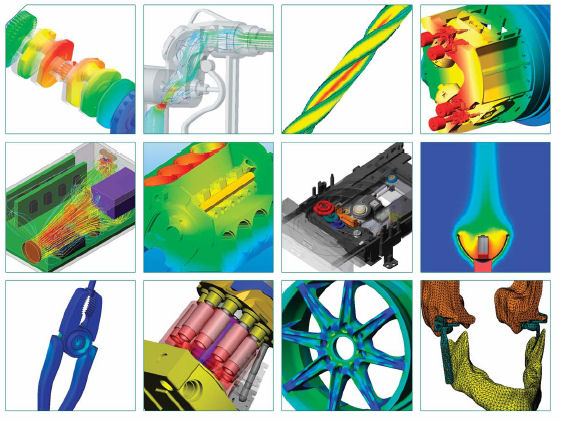
SOLIDWORKS Simulation is a suite of structural analysis solutions that use finite element analysis (FEA) to predict the physical behavior of a product in the real world by virtually testing CAD models. The portfolio includes solutions for linear, nonlinear static, and dynamic analysis, divided into three products: Simulation Standard, Simulation Professional, and Simulation Premium, each of which adds easy-to-use capabilities for solving increasingly complex problems.

Advantages

  • Quickly evaluates the performance of multiple variables.
  • Reduces time to market by quickly identifying optimal design solutions.
  • Predicts product performance, safety factor (FOS), and fatigue characteristics early in the process.
  • Reduces material costs. SOLIDWORKS Simulation allows design teams to safely eliminate unnecessary materials.
  • By pre-testing and refining your designs virtually, the costly testing and certification process is simplified, reducing time to market.

STANDARD

SOLIDWORKS Simulation Standard is an intuitive virtual testing environment for modeling static linear motion with time dependence and multicycle fatigue. It provides a parallel engineering approach, helping you determine whether your product will function properly and how long it will last — at the design stage.

PROFESSIONAL

SOLIDWORKS Simulation Professional allows for design optimization, determining the mechanical resistance of the product, product durability, topology, natural frequencies, and testing heat transfer and instability loss of stability. It can also perform sequential multiphysics modeling.

PREMIUM

SOLIDWORKS Simulation Premium allows for effective evaluation of designs for nonlinear and dynamic characteristics, dynamic loads, and composite materials. SOLIDWORKS Simulation Premium includes three advanced studies: nonlinear static, nonlinear dynamic, and linear dynamic.

COMPARISON OF FUNCTIONS
Standard
Professional
Premium
Ease of Use

SOLIDWORKS Simulation is fully integrated into SOLIDWORKS 3D CAD for ease of use and data integrity. Utilizing the same user interface (UI) paradigms as SOLIDWORKS, with toolbars, menus, and context-sensitive context menus, ensures quick familiarization. Built-in tutorials and online search assist in training and troubleshooting.

REUSE OF PROJECT DATA

SOLIDWORKS Simulation supports SOLIDWORKS materials and configurations for convenient analysis of multiple loads and product configurations.

STATIC RESEARCH

Solve structural analysis problems of parts and assemblies for stress, strain, displacements, and factors of safety (FOS). The problems are limited to static loading, elastic linear materials, and small contact displacements. For the solution to be correct, the obtained deformed shape after loading must have small displacements and rotations.

Only Premium: static studies are expanded by including components made from composite materials. The component setup includes layer orientation and sandwich definition. Results include layer failure index, as well as stresses and deflections.

FATIGUE RESEARCH

Evaluate the fatigue durability of components under multicycle variable loads, when the peak stress is below the material’s yield strength. The cumulative damage theory is used to predict the locations and cycles to failure.

MOTION ANALYSIS

Use the time-based kinematic and dynamic rigid body motion tool to calculate velocities, accelerations, and displacements of the assembly under working loads.

The motion analysis tool calculates loads on the component body and joints that can be imported into a static study.

Only Professional and Premium versions: use the event-based rigid body kinematics and dynamics tool to calculate velocities, accelerations, and displacements of the assembly under working loads when actions and movements are triggered by the position or motion of components.

The motion analysis tool calculates loads on the component body and joints that can be imported into a static study.

DESIGN RESEARCH

Design research is used to conduct a broad analysis of “what if.” In design research, both design parameters (models) and modeling settings (materials, loads, and fixtures) can be varied to assess the impact of changes on the model.

FEA MODELING

SOLIDWORKS Simulation includes modeling of solids, shells, and beams using h- and p-adaptive types of elements with mesh control and failure diagnostics.


A customizable material library is included in the modeling data:

  • Parallel computing (multicore)
  • Batch processing


For professionals and premium only:

  • 2D simplification
  • Plane stress
  • Plane strain
  • Axisymmetric
  • Submodeling
  • Submodeling: structural resistance analysis of the submodel from the main assembly.


Premium only:

  • Unload calculations
LOADS AND RESTRICTIONS
  • Fasteners for setting zero or non-zero displacements
  • Force, pressure, and remote structural loads
  • Thermal load
  • Import of flows/thermal loads
  • Load manager: assess the impact of various load combinations on your model.
CONNECTING THE ASSEMBLY
  • Component contact
  • State of the associated contact
  • Node to node, surface-to-surface contact state
  • Heat shrink fit state
  • Virtual wall state
  • Standalone contact
  • Connectors: bolt, spring, pin, elastic support, and bearing.
  • Connectors Safety check


For professionals and premium only:

  • Edge weld seam
  • Thermal contact resistance state
  • Isolated state
  • Connector for edge and spot welding
RESULTS OBTAINED
  • The results of the study depend on the type of research, but are displayed as contour plots, isosurfaces, surfaces, and sections.
  • The distribution of points and lines of quantity, defined by the probe.
  • The Design Insight graph shows the loaded material.
  • FEA results can be compared with test data.
  • Deformed shape results can be animated, and the animation can be saved.
  • Overlaying Simulation results on SOLIDWORKS graphics.
  • SOLIDWORKS Simulation results can be shared with users who are not SOLIDWORKS users via eDrawings®, a public 3D file format.
HELP AND SUPPORT

Built-in tutorials, interactive help, and knowledge base.

COMMUNICATION
  • Custom Simulation Report
  • eDrawings of Simulation Results
THERMAL ANALYSIS

Solve steady-state and transient thermal problems of components and assemblies for temperature, temperature gradient, and heat flux.

Upon completion of the thermal analysis, temperature loads can be imported into the static study.

FREQUENT STUDIES

Frequency studies determine the natural vibration modes of a product, which is important for products that experience vibration in their operating environment.

RESEARCH ON LOSS OF STABILITY

A possible mode of failure for long and slender components is rupture under loads below the material’s yield strength. The study of stability loss allows for the prediction of the stability loss factor of the components.

PRESSURE VESSEL INSPECTIONS

The linearized stress, which is key to calculating safe pressure, is calculated in the study of pressure vessels.

TOPOLOGICAL RESEARCH

Allows discovering new alternative structures with minimal materials under linear-elastic static load, while meeting the stiffness requirements of the components.

LINEAR DYNAMIC RESEARCH

Based on frequency analysis for calculating stresses due to forced vibrations and for calculating the effects of dynamic loads, impact or shock loads for linear-elastic materials. Types of analysis:

  • Modal time history analysis
  • Harmonic analysis
  • Random vibration analysis
  • Response spectrum analysis
NONLINEAR ANALYSIS

Nonlinear analysis allows for the examination of the behavior of complex materials such as metals, rubber, and plastics beyond the yield point, as well as accounting for large deviations and components in sliding contact.

Nonlinear static analysis assumes that static loads can be arranged in such a way that the dynamic effects of variable loads do not influence the study. Complex material models in nonlinear static analyses can be used to calculate permanent deformation and residual stresses due to excessive loads, as well as to predict the performance of components such as springs and clip fasteners.

Nonlinear dynamic analysis takes into account the influence of variable loads in real-time, which are incorporated into calculations and results. In addition to solving nonlinear static problems, nonlinear dynamic analyses can also address impact issues.